Transition To De-Amalgamation
The Snowy Valleys De-amalgamation Referendum was held on Saturday, 29 November 2025 with a definitive Yes vote being delivered by the community to reinstate two new councils based on the boundaries of the former Tumut (Northern) and Tumbarumba (Southern) Local Government Areas.
Council is now following the demerger pathway made possible by legislation introduced and passed by the state Government in 2024 towards a proposed proclamation date of 1 July 2028.
The Transition to De-amalgamation project will continue to be progressed in consultation with the NSW Office of Local Government, with further reports to be presented to Council as additional project milestones are reached.
The Snowy Valleys De-amalgamation Referendum was held on Saturday, 29 November 2025 with a definitive Yes vote being delivered by the community to reinstate two new councils based on the boundaries of the former Tumut (Northern) and Tumbarumba (Southern) Local Government Areas.
Council is now following the demerger pathway made possible by legislation introduced and passed by the state Government in 2024 towards a proposed proclamation date of 1 July 2028.
The Transition to De-amalgamation project will continue to be progressed in consultation with the NSW Office of Local Government, with further reports to be presented to Council as additional project milestones are reached.
-
Distribution of Assets and Liabilities
Share Distribution of Assets and Liabilities on Facebook Share Distribution of Assets and Liabilities on X (formerly Twitter) Share Distribution of Assets and Liabilities on Linkedin Email Distribution of Assets and Liabilities linkPublished 7 Oct 2026 - reproduced from local newspaper column
Welcome to the second edition of the Transition to De-amalgamation column, which aims to demystify the de-amalgamation process and provide insight into both the practical and legal aspects of the separation process.
Last month, we introduced the De-amalgamation Implementation Plan (DIP), that outlines activities to be undertaken before the new councils can be proclaimed. One of the most significant activities is the equitable distribution of assets, liabilities, finances and operational responsibilities between the two successor councils.
The DIP identifies five distribution methodologies:
- Method A: Based on LGA location
- Method BContinue reading
Published 7 Oct 2026 - reproduced from local newspaper column
Welcome to the second edition of the Transition to De-amalgamation column, which aims to demystify the de-amalgamation process and provide insight into both the practical and legal aspects of the separation process.
Last month, we introduced the De-amalgamation Implementation Plan (DIP), that outlines activities to be undertaken before the new councils can be proclaimed. One of the most significant activities is the equitable distribution of assets, liabilities, finances and operational responsibilities between the two successor councils.
The DIP identifies five distribution methodologies:
- Method A: Based on LGA location
- Method B: Asset/liabilities split - 60.3%/39.7%
- Method C: Road length
- Method D: Population; Number of rateable assessments
- Method E: Staff split per percentage of staff at amalgamation
These methodologies are underpinned by three principals:
- Community assets such as public halls, sportsgrounds, parks and reserves, public toilets etc. will be allocated to the new council where they lay. Operational assets such as water and wastewater undertakings, waste facilities, swimming pools etc. will also be allocated on the basis of where they lay, however other operational assets e.g. FOGO will be subject to separate consideration.
- All other assets and liabilities will be allocated on the contribution that the former Tumut and Tumbarumba councils made to Snowy Valleys Council on 12 May 2016 being: Tumbarumba Shire Council – 39.7% and Tumut Shire Council - 60.3%
- In constructing the initial budget for the new councils, it is likely that income and expenditure will need to be considered on a Cost Centre/Project basis.
A core function of the de-amalgamation Steering Committee, which comprises of the elected Council of Snowy Valleys and six community representatives as voting members, is to determine the distribution methodology for each asset and liability.
In its first meeting, the committee resolved the distribution methodology for any residual debt relating to the funding of de-amalgamation. Council has applied for borrowing from its externally restricted sewerage services reserve. If this borrowing is approved, at de-amalgamation each of the new Councils will need to pay back their portion of the borrowings as per the methodology determined by the Steering Committee.
At last weeks Steering Committee Meeting (1 October 2026) the committee determined the distribution methodology for a large number of councils Internal and External Cash reserves. When the proposal for proclamation is prepared in late 2027, these methodologies will be applied to each reserve with the oversight of the Steering Committee. Distribution schedules will be reported to the Steering Committee and available for public view.
Separate to the distribution of existing assets and liabilities, Council must establish the financial settings for each successor Council for a 10 year period, presented through the Long-term financial plan. To help inform this, Council has launched an important survey – seeking community input which will directly influence financial settings. Community members are strongly encouraged to complete the survey.
View Steering Committee papers on council's website www.svc.nsw.gov.au/DASC
Nicole Jenkins
Chief Transition Officer
-
Draft Financial Scenarios for the Northern and Southern Councils
Share Draft Financial Scenarios for the Northern and Southern Councils on Facebook Share Draft Financial Scenarios for the Northern and Southern Councils on X (formerly Twitter) Share Draft Financial Scenarios for the Northern and Southern Councils on Linkedin Email Draft Financial Scenarios for the Northern and Southern Councils link
Published 30 September 2026
Council's revised Long Term Financial Plan (LTFP) is now on public exhibition and includes initial modelling for the two proposed new councils ahead of the planned de-amalgamation on 1 July 2028.
Four scenarios have been modelled for each proposed council. They range from no change to current settings through to a combination of rate increases, reduced spending on materials and services, and changes to annual user fees and charges.
The current modelling shows that Scenario 4 is the only option that achieves financial sustainability for both proposed councils.
- For the proposed Northern Council, Scenario 4 includes an annual special rate variation of 4.3 per cent, in addition to the ordinary rate peg, together with reduced expenditure and changes to fees and charges.
- For the proposed Southern Council, Scenario 4 includes an annual special rate variation of 9.5 per cent, in addition to the ordinary rate peg, together with reduced expenditure and changes to fees and charges.
Community Survey
To support the public exhibition of the LTFP and assist Council to develop alternative scenarios, which reflect the different needs of both North and South communities, a community survey has also been developed that asks residents to consider:
- whether Council should increase revenue, reduce expenditure or use a combination of both;
- the balance between rates and service levels;
- the services and infrastructure that should be protected;
- services that could be reduced, delayed or delivered differently; and
- whether rate increases should be introduced gradually over eight years or more quickly over four years.
Community feedback will help shape and refine the scenarios, which will then be presented back to the community for further feedback before they are considered for approval by Council.
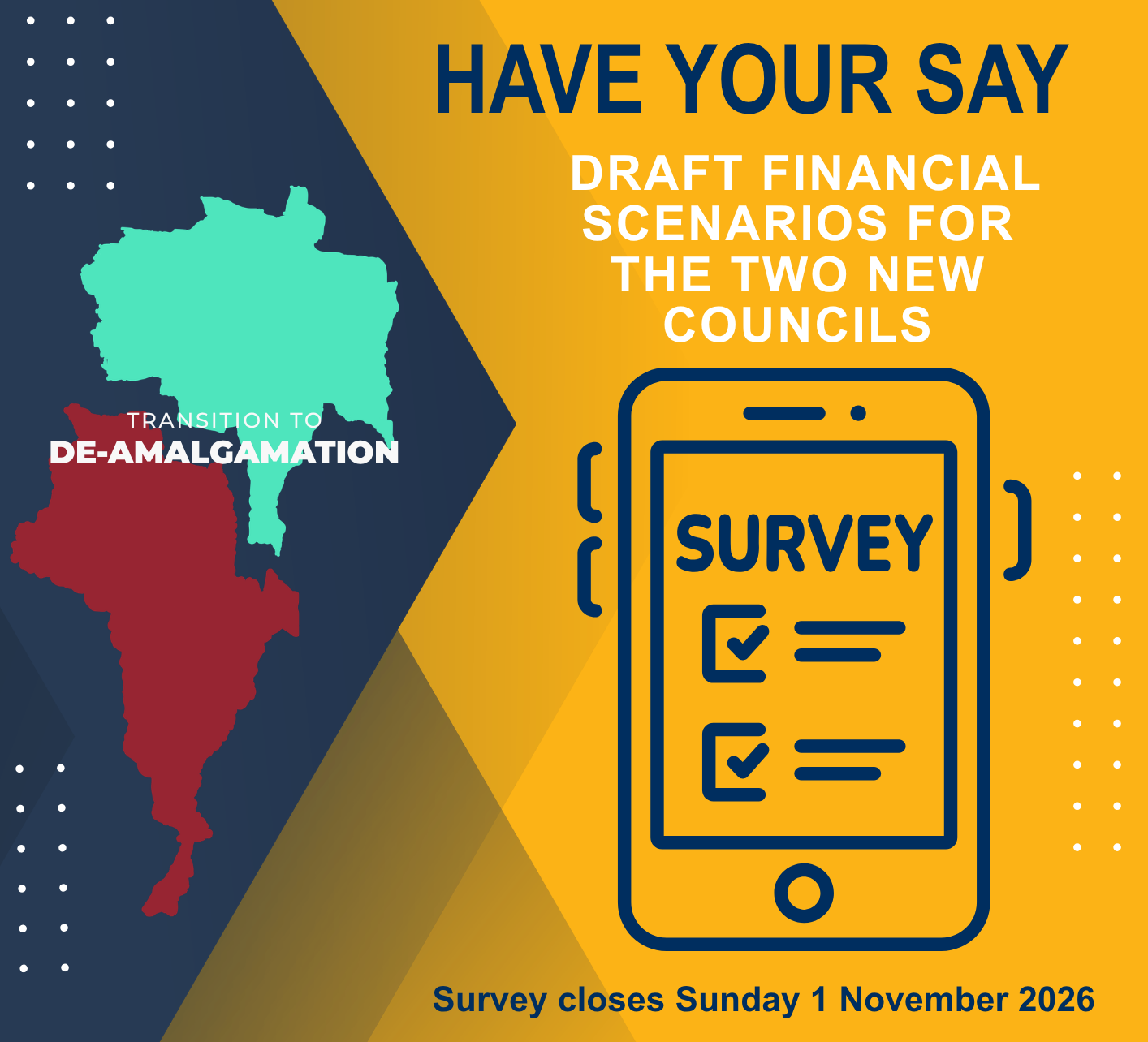
The revised Long Term Financial Plan feedback and the Two-Council Financial Modelling Survey will be open until Sunday 1 November 2026.
To review the plan and complete the survey, visit de-amalgamation-two-council-financial-modeling.
Read the full media story here
Published 30 September 2026
Council's revised Long Term Financial Plan (LTFP) is now on public exhibition and includes initial modelling for the two proposed new councils ahead of the planned de-amalgamation on 1 July 2028.
Four scenarios have been modelled for each proposed council. They range from no change to current settings through to a combination of rate increases, reduced spending on materials and services, and changes to annual user fees and charges.
The current modelling shows that Scenario 4 is the only option that achieves financial sustainability for both proposed councils.
- For the proposed Northern Council, Scenario 4 includes an annual special rate variation of 4.3 per cent, in addition to the ordinary rate peg, together with reduced expenditure and changes to fees and charges.
- For the proposed Southern Council, Scenario 4 includes an annual special rate variation of 9.5 per cent, in addition to the ordinary rate peg, together with reduced expenditure and changes to fees and charges.
Community Survey
To support the public exhibition of the LTFP and assist Council to develop alternative scenarios, which reflect the different needs of both North and South communities, a community survey has also been developed that asks residents to consider:
- whether Council should increase revenue, reduce expenditure or use a combination of both;
- the balance between rates and service levels;
- the services and infrastructure that should be protected;
- services that could be reduced, delayed or delivered differently; and
- whether rate increases should be introduced gradually over eight years or more quickly over four years.
Community feedback will help shape and refine the scenarios, which will then be presented back to the community for further feedback before they are considered for approval by Council.
The revised Long Term Financial Plan feedback and the Two-Council Financial Modelling Survey will be open until Sunday 1 November 2026.
To review the plan and complete the survey, visit de-amalgamation-two-council-financial-modeling.
Read the full media story here
-
Community Panel Begins Exploring the Future of Two Councils
Share Community Panel Begins Exploring the Future of Two Councils on Facebook Share Community Panel Begins Exploring the Future of Two Councils on X (formerly Twitter) Share Community Panel Begins Exploring the Future of Two Councils on Linkedin Email Community Panel Begins Exploring the Future of Two Councils link
Published 17 Sept 2026
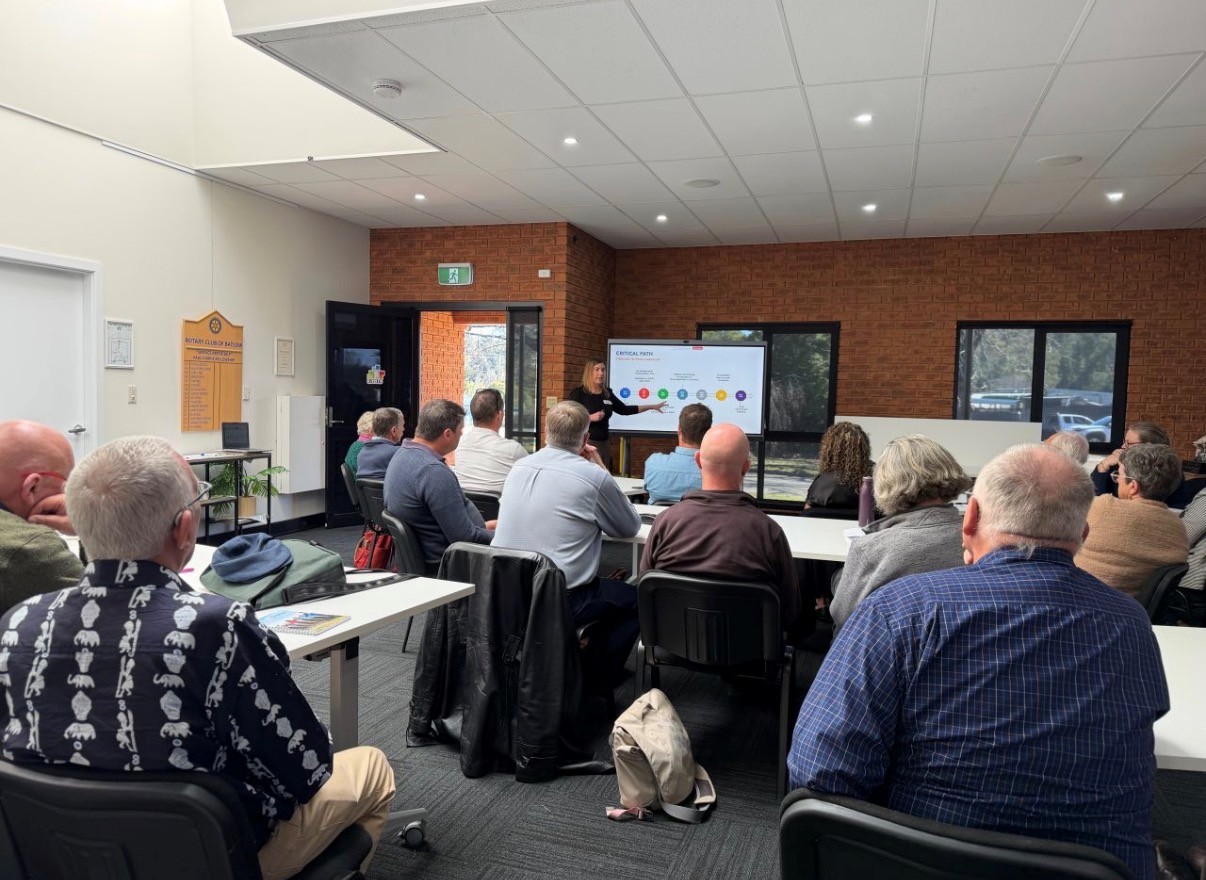
The first Snowy Valleys De-amalgamation Community Panel workshop was held last Friday at the Batlow Rotary Interactive Centre with near-full attendance, including 21 community representatives attending in-person.
The workshop marked the start of an important community-led conversation, with panel members showing a strong commitment to engaging constructively with the challenges and opportunities of de-amalgamation.
Council’s Chief Transition Officer Nicole Jenkins said the workshop highlighted a range of priorities for panel members as they look towards the future.
“While there are different perspectives across the panel, there is a shared interest in ensuring the future councils reflect the communities they serve,” Ms Jenkins said.
“Fair representation, transparency and protecting the unique identities of our towns were among the themes raised during the workshop.”
Members had the opportunity to build their understanding of the de-amalgamation process, agree on the scope of the panel’s work and identify the issues they want to explore throughout the project.
Read the full story here
Published 17 Sept 2026
The first Snowy Valleys De-amalgamation Community Panel workshop was held last Friday at the Batlow Rotary Interactive Centre with near-full attendance, including 21 community representatives attending in-person.
The workshop marked the start of an important community-led conversation, with panel members showing a strong commitment to engaging constructively with the challenges and opportunities of de-amalgamation.
Council’s Chief Transition Officer Nicole Jenkins said the workshop highlighted a range of priorities for panel members as they look towards the future.
“While there are different perspectives across the panel, there is a shared interest in ensuring the future councils reflect the communities they serve,” Ms Jenkins said.
“Fair representation, transparency and protecting the unique identities of our towns were among the themes raised during the workshop.”
Members had the opportunity to build their understanding of the de-amalgamation process, agree on the scope of the panel’s work and identify the issues they want to explore throughout the project.
Read the full story here
-
Transition to De-amalgamation
Share Transition to De-amalgamation on Facebook Share Transition to De-amalgamation on X (formerly Twitter) Share Transition to De-amalgamation on Linkedin Email Transition to De-amalgamation linkPublished 1 Sept 2026 - reproduced from local newspaper column
Welcome to the first edition of this monthly column, where we will help demystify the pathway to de-amalgamation and provide insight into both the practical and legal aspects of the separation process.
Under the de-amalgamation legislation, where a de-amalgamation proposal receives support from a majority of enrolled electors across the amalgamated area, the Minister for Local Government may recommend that the Governor of New South Wales issue a proclamation to give effect to the proposal.
Council is currently working towards submitting its proposal for proclamation to the Office of LocalContinue reading
Published 1 Sept 2026 - reproduced from local newspaper column
Welcome to the first edition of this monthly column, where we will help demystify the pathway to de-amalgamation and provide insight into both the practical and legal aspects of the separation process.
Under the de-amalgamation legislation, where a de-amalgamation proposal receives support from a majority of enrolled electors across the amalgamated area, the Minister for Local Government may recommend that the Governor of New South Wales issue a proclamation to give effect to the proposal.
Council is currently working towards submitting its proposal for proclamation to the Office of Local Government by December 2027. This timeline allows sufficient opportunity for the Office of Local Government and the Minister to undertake their due diligence and prepare the draft proclamation for consideration by the Governor, with a target commencement date of 1 July 2028.
Before a proclamation can be considered, Council must show that two separate and sustainable councils can be successfully established. This includes demonstrating:
- An appropriate distribution of assets, liabilities and staffing arrangements.
- Asset standards and proposed service levels for each new council.
- Opportunities to share existing assets, systems and programs where practical.
- Financial and workforce planning to support two sustainable councils over a 10-year period.
Work is progressing across each of these areas, supported by community engagement, the De-amalgamation Steering Committee and, more recently, the establishment of the Community Panel.
The foundation that the project is progressing from is the De-amalgamation Implementation Plan (DIP), which provides the framework to guide many of the decisions required throughout the separation process. Importantly, the plan outlines a range of methodologies for allocating assets and responsibilities between the proposed councils. In some cases, applying these methodologies is straightforward. In others, there may be grey areas that require careful consideration, sound judgement and community input.
Transparency remains a key principle throughout this process. Residents will have visibility of how decisions are being approached through Steering Committee discussions, Council reports and business papers. Where significant decisions are required, the community will also have opportunities to provide direct feedback through consultation activities and engagement with the Steering Committee.
A practical example of this approach can be seen in the recent decision regarding the Enterprise Resource Planning (ERP) system, the core business software that will support the operation of the two future councils.
The DIP identified the need for an ERP solution to be identified and implemented before the establishment of the new councils. Council staff subsequently undertook market research and prepared recommendations for the De-amalgamation Steering Committee. The committee, including community representatives, then considered the options and selected the preferred solution.
This demonstrates how technical decisions are being guided by the implementation plan while incorporating community representation in the decision-making process.
One of the most important discussions still to come relates to the services provided by future councils and the level at which those services are delivered.
From September, Council will commence extensive community consultation to understand local expectations across both the northern and southern regions. It is anticipated that service priorities may differ between communities, reflecting local needs and circumstances.
These conversations will also consider the relationship between service levels and rates. The new council areas may adopt different approaches to service delivery, balancing community expectations, service levels and affordability
The purpose of the consultation is to ensure the future councils are shaped by the people they serve and that community expectations are clearly understood before key decisions are made.
As we move forward, this column will continue to provide updates on the progress of de-amalgamation, explain the decisions being made and importantly highlight opportunities for community involvement.
Nicole Jenkins
Chief Transition Officer
-
Council Resolves De-amalgamation Funding Strategy
Share Council Resolves De-amalgamation Funding Strategy on Facebook Share Council Resolves De-amalgamation Funding Strategy on X (formerly Twitter) Share Council Resolves De-amalgamation Funding Strategy on Linkedin Email Council Resolves De-amalgamation Funding Strategy linkPublished on 21 Aug 2026
Following a project funding report that was considered by the De-amalgamation Steering Committee, Council has approved proceeding with internal loan funding arrangements and grant applications to the Office of Local Government to support the project's implementation, ensuring both successor councils are operationally ready for commencement on 1 July 2028.
The revised cost estimate for the de-amalgamation project is projected at $4,985,640, inclusive of a 20% budget contingency.
To assist with the costs of de-amalgamation, Council will:
- Submit an application to the Minister for Local Government for grant funding of $2,891,640
- Formally apply to the DeputyContinue reading
Published on 21 Aug 2026
Following a project funding report that was considered by the De-amalgamation Steering Committee, Council has approved proceeding with internal loan funding arrangements and grant applications to the Office of Local Government to support the project's implementation, ensuring both successor councils are operationally ready for commencement on 1 July 2028.
The revised cost estimate for the de-amalgamation project is projected at $4,985,640, inclusive of a 20% budget contingency.
To assist with the costs of de-amalgamation, Council will:
- Submit an application to the Minister for Local Government for grant funding of $2,891,640
- Formally apply to the Deputy Secretary, Local Government for approval to borrow $500,000 from Council’s Sewerage Services General Reserve
- Reprioritise $500,000 from Council’s current 26/27 Operational Budget
The proposed funding framework demonstrates Council’s commitment to co-investment, with more than 40% of direct project costs to be funded by Council. This investment is further supported by substantial in-kind contributions through the provision of staff time, resources and specialist expertise.
Funding Source Value Expenditure within the adopted 2026/2027 Operational Budget be reprioritised to provide funding towards de-amalgamation project costs.
(combination of realised savings, the reprioritisation of existing budget allocations, and, where applicable, transfers from redundant internal reserves)
$500,000 Transition Management Office (TMO) costs, including the Chief Transition Officer (CTO) position and supporting resources, to be funded from the adopted FY2026/2027 Employee Expenses Budget and the forecast FY2027/2028 Employee Expenses Budget. $650,000 Recognise cost associated with referendum already paid in FY 2025/2026 $240,000 Temporary borrowing from External Loan from Sewer Reserve. (Repayments of the proposed borrowings will be funded through future rate revenue and incorporated into rate-setting processes, including Special Rate Variations, as part of the proclamation proposal) $500,000 Recognise the costs associated with the September 2028 Local Government elections as operational expenditure to be funded by the successor councils through their respective 2028/2029 Operational Budgets.
$130,000 Reduced contingency accounting for referendum costs being confirmed, and separation of Council Election costs:
- Referendum – Contingency: $48,000
- Future election – Contingency: $26,000
$74,000 Application for Government Grant funding
(In the event that the grant application is unsuccessful, the project funding shortfall would need to be addressed through a combination of additional allocations in the 2027/2028 Operational Budget and/or additional borrowings against Council reserves.)$2,891, 640 TOTAL $4,985,640 -
De-amalgamation Steering Committee to Hold Inaugural Meeting
Share De-amalgamation Steering Committee to Hold Inaugural Meeting on Facebook Share De-amalgamation Steering Committee to Hold Inaugural Meeting on X (formerly Twitter) Share De-amalgamation Steering Committee to Hold Inaugural Meeting on Linkedin Email De-amalgamation Steering Committee to Hold Inaugural Meeting linkPublished on 03 August 2026
The Snowy Valleys Council De-amalgamation Steering Committee will meet for the first time on Thursday 6 August at the Snowy Valleys Resilience Hub in Batlow, marking an important milestone in the transition towards two independent councils.
Community representatives Allan Tonkin, Barney Hyams, John Connors, Mary Hoodless AM, Ian Chaffey and Andrew Rae will join elected Councillors and Council Executive staff (non-voting members) for the inaugural meeting, which will commence at 4.15pm.
The meeting agenda includes the election of a Chair, confirmation of future meeting arrangements, consideration of a proposed project funding strategy, selection of the Community Panel members and a confidential report regarding Council’s primary technology platform.
The meeting will be open to the public and community members are welcome to attend as observers, but the meeting will not be livestreamed.
Read the full article here
Published on 03 August 2026
The Snowy Valleys Council De-amalgamation Steering Committee will meet for the first time on Thursday 6 August at the Snowy Valleys Resilience Hub in Batlow, marking an important milestone in the transition towards two independent councils.
Community representatives Allan Tonkin, Barney Hyams, John Connors, Mary Hoodless AM, Ian Chaffey and Andrew Rae will join elected Councillors and Council Executive staff (non-voting members) for the inaugural meeting, which will commence at 4.15pm.
The meeting agenda includes the election of a Chair, confirmation of future meeting arrangements, consideration of a proposed project funding strategy, selection of the Community Panel members and a confidential report regarding Council’s primary technology platform.
The meeting will be open to the public and community members are welcome to attend as observers, but the meeting will not be livestreamed.
Read the full article here
-
Community Representatives Join De-amalgamation Steering Committee
Share Community Representatives Join De-amalgamation Steering Committee on Facebook Share Community Representatives Join De-amalgamation Steering Committee on X (formerly Twitter) Share Community Representatives Join De-amalgamation Steering Committee on Linkedin Email Community Representatives Join De-amalgamation Steering Committee linkPublished on 09 July 2026
Snowy Valleys Council has appointed six community representatives to its De-amalgamation Steering Committee, ensuring local voices continue to play a key role in shaping the future of the region.
The appointed community representatives are:
Northern Area
- Allan Tonkin (Tumut)
- Barnett (Barney) Hyams (Batlow)
- John Connors (Batlow)
Southern Area
- Mary Hoodless AM (Jingellic)
- Ian Chaffey (Tumbarumba)
- Andrew Rae (Tumbarumba)
Mayor Julia Ham said "We received a high calibre of nominations, and I'd like to congratulate the successful applicants and sincerely thank everyone who took the time to apply."
Council's Chief Transition Officer, Nicole Jenkins, said the Steering Committee would provide strategic leadership, oversight and governance throughout the separation and re-establishment of the two new independent councils.
Read the full media article here
Published on 09 July 2026
Snowy Valleys Council has appointed six community representatives to its De-amalgamation Steering Committee, ensuring local voices continue to play a key role in shaping the future of the region.
The appointed community representatives are:
Northern Area
- Allan Tonkin (Tumut)
- Barnett (Barney) Hyams (Batlow)
- John Connors (Batlow)
Southern Area
- Mary Hoodless AM (Jingellic)
- Ian Chaffey (Tumbarumba)
- Andrew Rae (Tumbarumba)
Mayor Julia Ham said "We received a high calibre of nominations, and I'd like to congratulate the successful applicants and sincerely thank everyone who took the time to apply."
Council's Chief Transition Officer, Nicole Jenkins, said the Steering Committee would provide strategic leadership, oversight and governance throughout the separation and re-establishment of the two new independent councils.
Read the full media article here
-
Council To Retain SVC Brand Following Community Feedback
Share Council To Retain SVC Brand Following Community Feedback on Facebook Share Council To Retain SVC Brand Following Community Feedback on X (formerly Twitter) Share Council To Retain SVC Brand Following Community Feedback on Linkedin Email Council To Retain SVC Brand Following Community Feedback linkPublished on 03 July 2026
At its Extraordinary Meeting held on 2 July, Council has resolved to retain the existing Snowy Valleys Council (SVC) brand following the outcomes of a community survey undertaken as part of the de-amalgamation process.
In line with the community survey results, which showed strong community support for maintaining the current SVC identity, Council resolved to retain the Snowy Valleys Council brand and extend its use to the new northern Council (formerly the Tumut Shire Council area) upon proclamation.
Read the full article here
Published on 03 July 2026
At its Extraordinary Meeting held on 2 July, Council has resolved to retain the existing Snowy Valleys Council (SVC) brand following the outcomes of a community survey undertaken as part of the de-amalgamation process.
In line with the community survey results, which showed strong community support for maintaining the current SVC identity, Council resolved to retain the Snowy Valleys Council brand and extend its use to the new northern Council (formerly the Tumut Shire Council area) upon proclamation.
Read the full article here
-
Minister Visits Snowy Valleys To Discuss De-Amalgamation
Share Minister Visits Snowy Valleys To Discuss De-Amalgamation on Facebook Share Minister Visits Snowy Valleys To Discuss De-Amalgamation on X (formerly Twitter) Share Minister Visits Snowy Valleys To Discuss De-Amalgamation on Linkedin Email Minister Visits Snowy Valleys To Discuss De-Amalgamation linkPublished on 03 July 2026
Minister for Local Government, the Hon. Ron Hoenig, recently met with Snowy Valleys Council to discuss progress on de-amalgamation and the work required to establish two new councils by July 2028.
During the visit, the Minister highlighted the opportunity to create two councils with services and operating models tailored to the unique needs of their respective communities, rather than replicating the current structure.
Council's Chief Transition Officer, Nicole Jenkins, said the meeting reinforced the importance of carefully planning services, service levels and financial sustainability to meet the priorities of each future council area.
Mayor Julia Ham said the Minister recognised the complexity of the task ahead and stressed the importance of building two distinct councils that reflect the needs of their communities. The Minister also acknowledged the significant work involved and expressed confidence that Council is well placed to deliver the transition.
Read the full article here
Published on 03 July 2026
Minister for Local Government, the Hon. Ron Hoenig, recently met with Snowy Valleys Council to discuss progress on de-amalgamation and the work required to establish two new councils by July 2028.
During the visit, the Minister highlighted the opportunity to create two councils with services and operating models tailored to the unique needs of their respective communities, rather than replicating the current structure.
Council's Chief Transition Officer, Nicole Jenkins, said the meeting reinforced the importance of carefully planning services, service levels and financial sustainability to meet the priorities of each future council area.
Mayor Julia Ham said the Minister recognised the complexity of the task ahead and stressed the importance of building two distinct councils that reflect the needs of their communities. The Minister also acknowledged the significant work involved and expressed confidence that Council is well placed to deliver the transition.
Read the full article here
-
Council Appoints Chief Transition Officer for De-Amalgamation
Share Council Appoints Chief Transition Officer for De-Amalgamation on Facebook Share Council Appoints Chief Transition Officer for De-Amalgamation on X (formerly Twitter) Share Council Appoints Chief Transition Officer for De-Amalgamation on Linkedin Email Council Appoints Chief Transition Officer for De-Amalgamation linkPublished on 12 March 2026
Snowy Valleys Council has appointed a Chief Transition Officer to oversee the de-amalgamation process.
Council’s General Manager Jessica Quilty said the appointment followed an extensive recruitment process. “I am pleased to advise that Ms Nicole Jenkins has accepted the role as our Chief Transition Officer,” said Ms Quilty. “This role is critical to successfully delivering the transition and Ms Jenkins brings extensive experience providing strategic advice and leading organisational responses to complex projects and change initiatives.”
Key accountabilities of the role include leading Council’s Transition Team and developing an organisational change initiative and associated roadmap for de-amalgamation. Financially, the development of budgets and plans that support sound fiscal management and sustainability of the two new separate organisations will be critical.
Ms Jenkins will commence her role with Snowy Valleys Council on 8 April 2026.
Read the full article here
Published on 12 March 2026
Snowy Valleys Council has appointed a Chief Transition Officer to oversee the de-amalgamation process.
Council’s General Manager Jessica Quilty said the appointment followed an extensive recruitment process. “I am pleased to advise that Ms Nicole Jenkins has accepted the role as our Chief Transition Officer,” said Ms Quilty. “This role is critical to successfully delivering the transition and Ms Jenkins brings extensive experience providing strategic advice and leading organisational responses to complex projects and change initiatives.”
Key accountabilities of the role include leading Council’s Transition Team and developing an organisational change initiative and associated roadmap for de-amalgamation. Financially, the development of budgets and plans that support sound fiscal management and sustainability of the two new separate organisations will be critical.
Ms Jenkins will commence her role with Snowy Valleys Council on 8 April 2026.
Read the full article here
Community feedback on the initial ‘two-council’ financial modelling, as set out in the revised Long Term Financial Plan, is critical to help us understand community priorities and the trade-offs between service levels, asset renewal, financial sustainability and affordability.
The community survey asks residents to consider:
- whether Council should increase revenue, reduce expenditure or use a combination of both;
- the balance between rates and service levels;
- the services and infrastructure that should be protected;
- services that could be reduced, delayed or delivered differently; and
- whether rate increases should be introduced gradually over eight years or more quickly over four years.
-
20 August 2026
-
20 August 2026
-
02 July 2026
-
02 July 2026
-
21 May 2026
-
20 August 2026 - 10.6 DE-AMALGAMATION PROJECT FUNDING STRATEGY REPORT (474 KB) (pdf)
-
21 May 2026 - 10.2 DE-AMALGAMATION PROJECT REPORT (345 KB) (pdf)
-
SVC De-amalgamation Implementation Plan – December 2024 (3.16 MB) (pdf)
-
SVC Brand Retention Survey - Survey Responses (4.45 MB) (pdf)
-
FAQs- Retention of SVC brand (200 KB) (pdf)
-
NJ
Phone 1300 275 782 Email info@svc.nsw.gov.au